Closing the Loop on OT Defense
Traditional Operational Technology (OT) security has long centered on visibility, network segmentation, and human-driven detection and response. Specialized platforms such as Dragos, Claroty, Nozomi Networks, and Microsoft Defender for IoT have significantly improved asset discovery, threat detection, and monitoring in industrial environments. Yet the core decision-making and response cycle has remained fundamentally human.
That model is reaching its practical limits.
Modern cyber threats move at machine speed. Meanwhile, industrial facilities face a chronic shortage of dual-domain professionals who understand both automation engineering and advanced cybersecurity. This velocity gap introduces dangerous delays when minutes or seconds determine physical consequences. Passive visibility is no longer enough to protect modern critical infrastructure.
Adaptive Operational Technology (AOT) is the evolution of OT network defense into an AI-centric paradigm. Supported by the growth of powerful compute capabilities at the edge, artificial intelligence moves beyond advisory analytics. It becomes the primary engine for continuous assessment, decision-making, and response — disrupting traditional linear response schemas by shifting mitigation from human speed to machine speed.
The 4-Layer AOT Framework
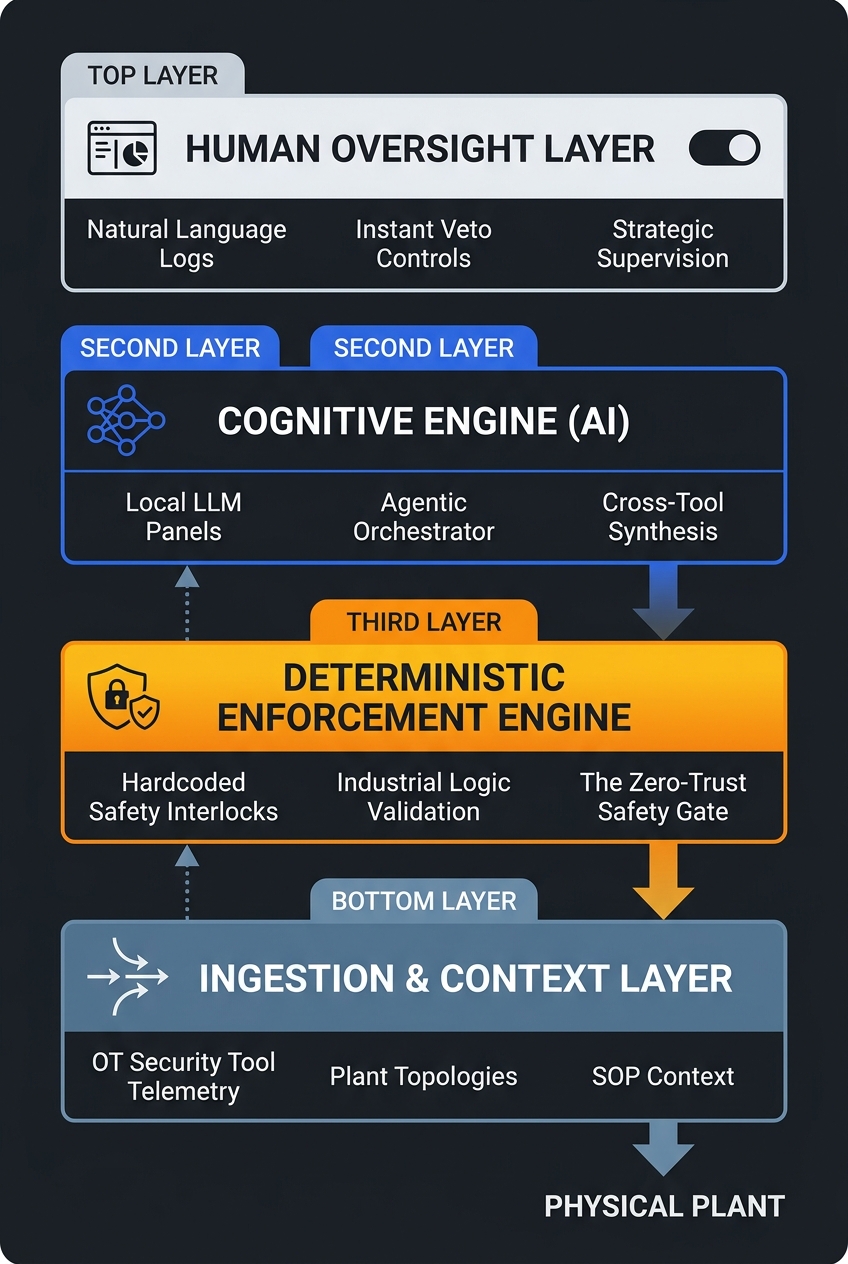
AOT compresses the time-to-mitigation from hours to seconds by introducing a four-layer architecture that integrates seamlessly above your existing security stack:
Human Oversight Layer
Displays real-time operational context logs in natural language and provides instant veto capabilities, transitioning human operators from manual, high-stress responders into high-level strategic supervisors.
Cognitive Engine (AI)
A network of specialized AI agents running localized, private language models that interpret alerts in operational terms, analyze threat vectors, and instantly formulate tailored cyber-resilience playbooks. This layer is strictly advisory.
Deterministic Enforcement Engine
A safety-critical, zero-trust software gate running hardcoded rules independent of the AI. It validates all proposed AI mitigation actions against physical safety interlocks and standard industrial logic before execution. No command touches the plant without passing through this filter.
Ingestion & Context Layer
Continuously ingests passive telemetry from current OT security tools, correlating it with static, localized plant topologies and standard operating procedures (SOPs).
Absolute Safety Guardrails
To operate safely inside an industrial environment, the AOT framework implements four unyielding design rules:
The Advisory Boundary
The Cognitive Engine possesses 0% direct execution authority over physical actuators or OT networks. It can only propose playbooks.
The Enforcement Gate
Execution is handled entirely by the hardcoded Enforcement Engine. It plays a "matching game" to trigger pre-configured industrial macros written by human engineers. The AI does not invent custom process commands.
The Deterministic Feedback Loop
If the Enforcement Gate blocks an AI action due to a safety violation, it returns a standardized error code. The Cognitive Engine instantly ingests this code as an immutable constraint and recalculates a safe alternative playbook without looping or freezing.
Network Fabric Prerequisite
AOT operates at the modern network fabric layer (SDN, industrial firewalls, DPUs) to isolate network pathways around legacy devices, rather than interacting with legacy PLCs directly over serial protocols.
The AOT Predictive Maturity Curve
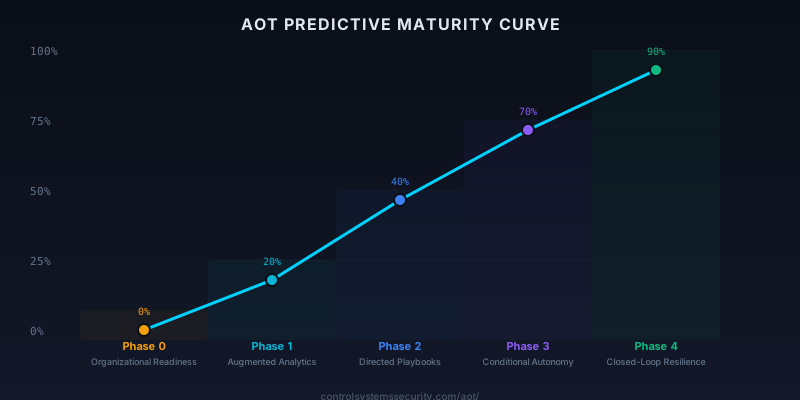
Transitioning to an AOT paradigm is a journey of progressive trust. Organizations do not hand over the keys to the plant floor overnight. Implementation follows a strict maturity curve — beginning with organizational readiness: roles, competencies, and change management infrastructure, all validated before any technology ships. This work runs in parallel with technical architecture design.
Phase 0: Organizational Readiness
Before AOT deployment, the organization must pass a readiness assessment covering: named AOT Operators and Macro Custodians with documented competency; an IT/OT Liaison bridging corporate security and plant operations; a Process Engineer Representative who understands physical process safety; confirmed organizational commitment; MOC integration for macro updates. Any unmet items require documented remediation plans with firm deadlines. This is not self-certification — operators must pass tabletop exercises and written competency exams. Commitment is confirmed, not just claimed. No technology ships until the gate is passed.
Phase 1: Augmented Analytics
The local LLM translates multi-tool alerts into natural language plant telemetry. Human operators are 100% in-the-loop, handling all manual copy, paste, and execution of recommended playbooks.
Phase 2: Directed Playbooks
The Cognitive Engine generates localized, pre-validated containment scripts. Human operators remain in-the-loop, reviewing the script and executing it via a single-click "Approve" button inside the dashboard.
Phase 3: Conditional Autonomy
The Cognitive Engine instantly shoots a pre-configured containment playbook to the enforcement gate. The gate verifies it against hardcoded safety limits and executes it. Human operators are on-the-loop, receiving an alert with a 5-second countdown to hit a "Veto" kill-switch.
Phase 4: Closed-Loop Resilience
AI agents manage end-to-end incident containment at true machine speed (milliseconds) across production environments within strictly defined safety boundaries. Humans operate by exception, receiving notifications after containment occurs to handle forensic recovery.
AOT does not discard current tools; it sits above them, synthesizing their output and accelerating response times. By transforming AI from a passive dashboard advisor into an active, protective shield, AOT ensures the physical world can defend itself at the speed of the digital threats targeting it.
→ See the full Maturity Curve with promotion criteria · → Browse the Research Vault